Advancing Coral Reef Protection Through National Coordination in Indonesia
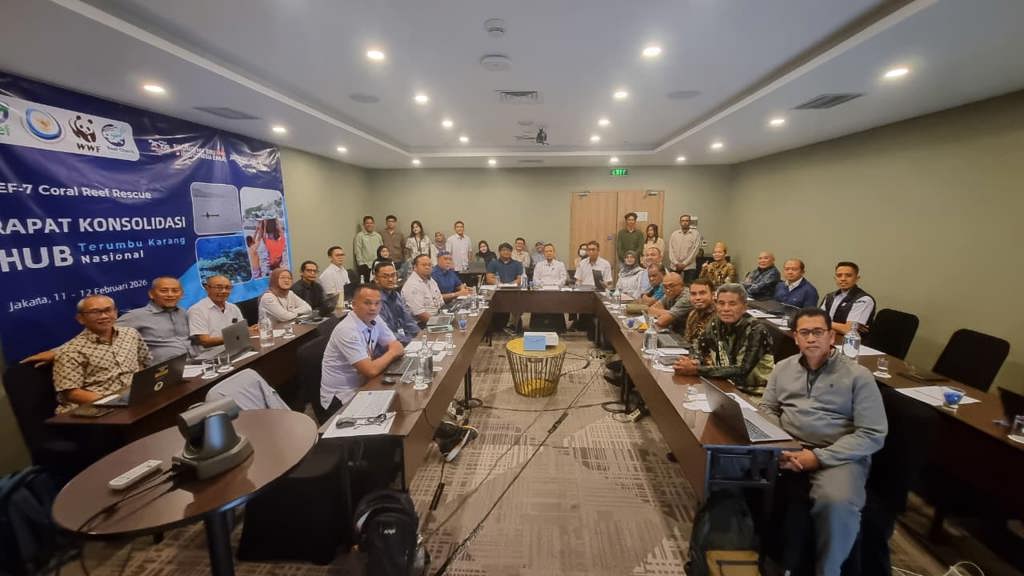
In Indonesia, collaborative consultations are leading to concrete progress on the ground to conserve climate resilient coral reefs. In February 2026, Yayasan Reef Check Indonesia, in collaboration with the Directorate of Ecosystem Conservation under the Directorate General of Marine Management, Ministry of Marine Affairs and Fisheries (MMAF), successfully held the National Reef Hub Consolidation Meeting in Cikini. The meeting was part of the implementation of the GEF-7 Coral Reef Rescue (CRR) Project aimed at strengthening the protection and management of climate-resilient reefs in Indonesia.
Inclusive Community Participation key to success for Coral Reef Conservation.
Dr. Firdaus Agung, the Director of Ecosystem Conservation, MMAF and GPSC, officially opened the meeting and emphasized the importance of community participation in coral reef management. In his remarks, Dr Agung highlighted that the implementation of the National Hub and its related studies should actively involve local communities and grassroots stakeholders as key actors in conservation efforts.
The consolidation meeting brought together a wide range of stakeholders, including government representatives, academics, civil society organizations, conservation practitioners, and community representatives from priority climate-resilient coral reef regions across Indonesia.
Innovative Buddy System Ensuring all Voices are heard
To support deeper participation from underrepresented groups, the National Coral Reef Hub supports a “buddy system”, which encourages collaboration between local community groups and supporting institutions such as NGOs, universities, and local organizations to strengthen mentoring and knowledge exchange. One example of this buddy system is the collaboration between the Gelora Kiabu Community Group and Anambas Foundation in Anambas in supporting community-based coastal and marine ecosystem conservation efforts. Together with BPK Pekanbaru (a MMAF field technical unit), Anambas Foundation support Gelora Kiabu to increase their active involvement and commitment in managing the Anambas MPA, through monitoring coral reef health and adopting corals for rehabilitation purposes. This dedication to partnership building reflects the Hub's commitment to inclusive, community-led conservation.
Through this approach, the National Coral Reef Hub is expected to function not only as a coordination platform, but also as a space for shared learning, capacity strengthening, and collaborative mechanisms that support decision-making processes in marine conservation management, including responses to climate change impacts such as coral bleaching events.
Renewed focus on Sustainable Finance and Reef Friendly Businesses
One of the key outcomes of the February meeting was the agreement among Hub members to initiate several strategic studies, including mapping community-based MSMEs (Micro, Small and Medium Enterprises) and “Reef Friendly” businesses. The hub will focus on conducting Threat-Opportunity and Cost-Benefit analyses, as well as developing strategies for implementing “community vision” processes to better understand local aspirations and lessons learned from community-level conservation practices.
Discussions throughout the meeting were conducted actively through plenary sessions and several focused group discussions. Participants shared inputs and recommendations aimed at strengthening the institutional framework and future implementation of the National Coral Reef Hub.
Provincial, Regional and Site level engagement essential for implementation of effective coral reef conservation
M. Arsyad, IPB University, representing the academic sector within the Hub, emphasized that the Hub’s institutional structure should be layered and decentralized rather than concentrated solely at the national level. He highlighted how strengthening coordination mechanisms at provincial, regional, and site levels is essential to ensure more effective and locally relevant implementation.
A similar perspective was shared by Nyoman Sugiarta, representing community stakeholders, who highlighted the importance of strengthening institutional arrangements and operational frameworks for the Hub at local and site levels to support long-term conservation implementation involving local communities directly.
As a follow-up to the consolidation meeting, the planned studies and workshops at site level will be carried out collaboratively with Hub members and local partners in priority areas. This collaborative approach is expected to strengthen shared learning processes, enhance community capacity, and ensure that coral reef conservation efforts are implemented in a participatory and sustainable manner.
Through this forum, the National Coral Reef Hub is expected to become an effective coordination platform for supporting the protection of climate-resilient coral reefs in Indonesia, while strengthening collaboration among government institutions, academia, civil society organizations, private sector actors, and coastal communities in safeguarding the sustainability of Indonesia’s marine ecosystems.
About the Coral Reef Rescue Project
The Coral Reef Rescue Project is a US$7M initiative funded by the Global Environment Facility to build capacity and solutions that ensure the long-term survival of climate refuge coral reef ecosystems and the communities that depend on them. The project is implemented by the World Wildlife Fund and executed by The University of Queensland in partnership with Wildlife Conservation Society (Fiji, Madagascar, Solomon Islands), Yayasan Reef Check Indonesia, Palawan Council for Sustainable Development, Philippines and Marine Parks and Reserves Unit, Tanzania.
Free Online Resources for Coral Reef Conservation
Complementing the work in each country, the GEF 7 CRR project has released free online courses on coral reefs. These include Coral Reefs: Introduction to Challenges and Solutions, Coral Reefs: Sustainable Blue Economy, Coral Reefs: Data and Monitoring, Coral Reefs: Climate Resilient Communities. Courses are available in English, Bahasa Indonesian, and French.
Alongside these courses, a new online decision support tool was created: Coral Reef Rescue Portal. This brings together over 70 existing coral reef datasets and resources in one easy-to-use, searchable platform.
.jpg)