Ambon Workshops – ClimateREEFS and Coral Reef Rescue Project
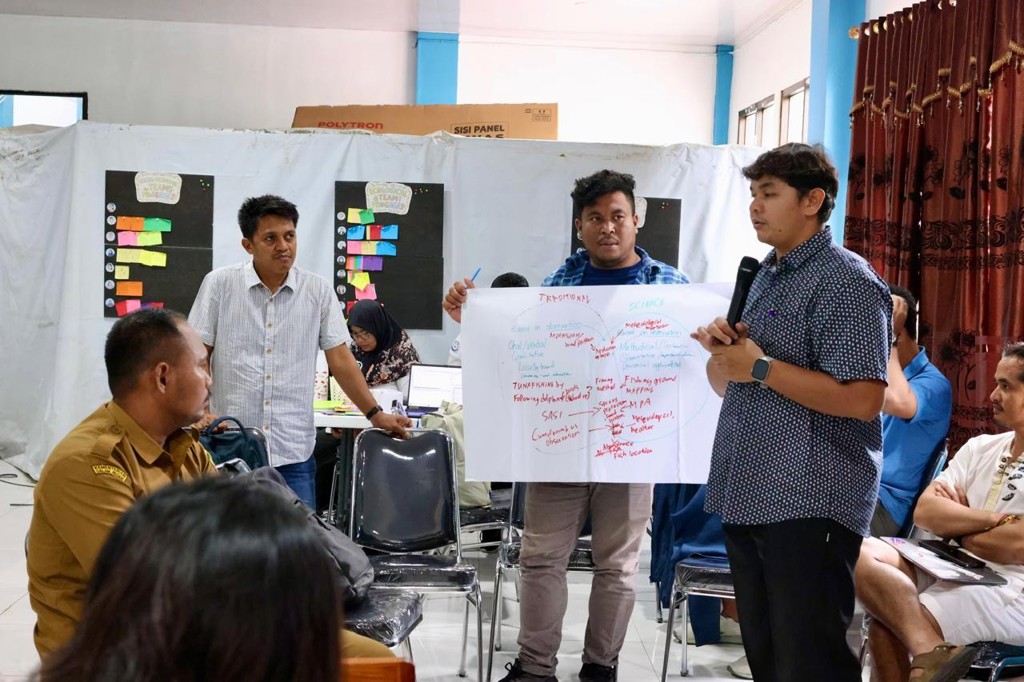
In November 2025, a joint workshop led by ClimateREEFS and the GEF Coral Reef Rescue Project was officially opened by the Ministry of Marine Affairs and Fisheries and the National Research and Innovation Agency in Ambon, Indonesia. In their opening address, these key government organisations highlighted the current status of coral reefs in Indonesia and the challenges ahead.
Fiona Chong, project manager and postdoctoral researcher at the University of Leeds, UK, and ClimateREEFS, highlighted the importance of in-person workshops and collaboration for coral reef conservation,
“There are many synergies between the goals of the GEF 7 Coral Reef Rescue Project and those of the ClimateREEFS project. Researchers often work in silos despite their best attempts to cross-disciplinary boundaries, but we know that climate change adaptation requires a holistic approach. The IntegrateAdapt workshop addressed this challenge by facilitating conversations and collaborations between researchers working with genomic, ecological, socio-economic and gender data.”
She added, “These workshops aligned with the content of the GEF 7 CRR online courses that attendees had a taster of over the 1.5 days, which span from coral bleaching to ecosystem resilience to sustainable blue economies. Our early career researchers were encouraged to ‘think outside of the box’ and consider the applied effects of our research, and the potential impacts that they might have for stakeholders locally and beyond.”
The GEF Coral Reef Rescue Project workshop also engaged participants from universities, government agencies (including the Marine and Fisheries Office of Maluku Province and the Fisheries Office of Ambon City), and local NGOs that lead conservation initiatives or work closely with coastal communities and ecosystems.
Ray Purnama (Marine and Fisheries Office of Maluku Province) highlighted the importance of workshops like these,
“The GEF Coral Reef Rescue training supports us, as government officials, in carrying out community awareness programs that highlight the vital role of coral reefs in sustaining the livelihoods of coastal communities for the future."
The workshop began with the GEF 7 CRR team sharing the outputs of the project to date, which include the Coral Reef Rescue Portal and online courses. This workshop provided an opportunity for the GEF 7 CRR learning and development team to translate their current online self-paced courses into short, facilitated in-person workshops.
Following this introduction, Professor Ove Hoegh-Guldberg gave a brief presentation focused on the online course Coral Reefs: Introduction to Challenges and Solutions. Professor Ove also shared insights into the latest scientific findings on global warming and coral reef health.
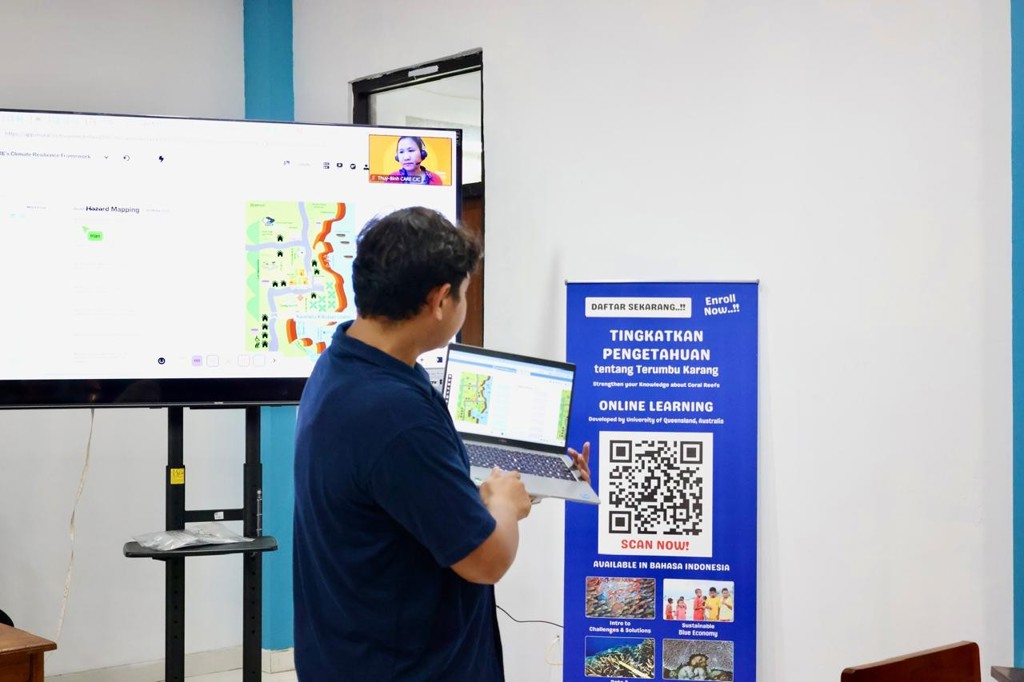
To conclude the first day, representatives from The Climate Adaptation, Resilience, and Empowerment (CARE) Program took the workshop into a participatory session focusing on CARE's climate resilience framework. Through practical activities, participants explored climate resilience and community insights using tools such as hazard mapping.
Ragiel Faturahman (Yasi.ID NGO) benefited from participating in these workshops,
“As an early-career professional in the NGO sector, the GEF Coral Reef Rescue training has been incredibly valuable in expanding my knowledge and understanding of conservation, particularly the critical role of coral and marine ecosystems in regulating the Earth’s climate.”
The second day of the workshop began with an overview of sustainable blue economy concepts, Coral Reefs: Sustainable Blue Economy. This session highlighted how shifting to a sustainable blue economy can help address the challenges of climate change, biodiversity loss and resource overuse that threaten ocean and coral reef systems.
Data collection and analysis followed, with an introduction to the new Data and Monitoring Course, focusing on the value of integrating traditional and scientific data/information, and the newly launched Coral Reef Rescue Portal. The newly launched Coral Reef Rescue Portal brings together over 70 existing coral reef datasets and resources on an easy-to-use platform. Designed to bridge the gap between science and on-the-ground conservation, this portal links governments, NGOs, local communities, and field operators with a curated listing of vital data and digital tools to support evidence-based decision-making and collaboration.
The Ambon workshops showed how collaboration can turn research into practical solutions for coral reef conservation. By combining global tools like the Coral Reef Rescue Portal with local knowledge, participants learned new ways to protect reefs and support communities that rely on them. This event strengthened partnerships and set the stage for future action toward a sustainable and climate-resilient ocean.
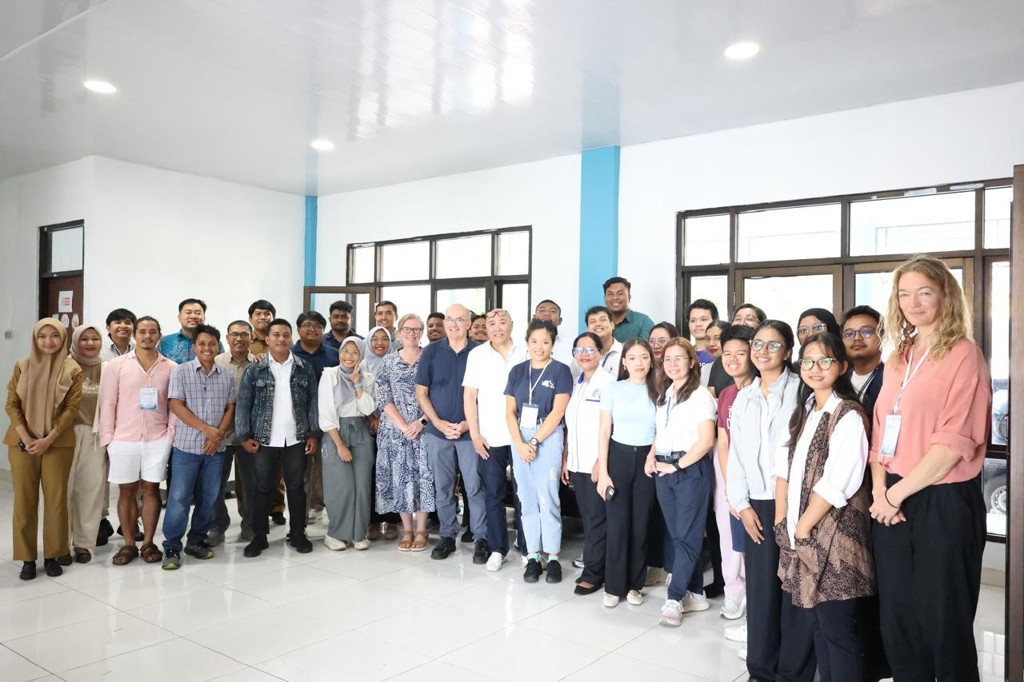
Thank you to the ClimateREEFS team at Pattimura University: Cilun Djakiman, Rindah Talitha Vida, James Rupiasa, Janet Rande, Prandito Simanjuntak, Fajrin Rahayaan for organising and facilitating such a meaningful event and for providing a seamless experience for the participants by assisting with translating when necessary.
Thank you to all the partners involved with this event, both online and in person: Derta Prabuning and Imron Rosadi (Reef Check Indonesia); Professor Ove Hoegh-Guldberg, Jennifer Dunn, Erin Lord-Lynch, Loren Recchi-Bannah, and Melanie Johnson (University of Queensland). Thank you to Thuy Binh and Farida (CARE) for facilitating the in-person workshops. Thank you to our collaborating partner Yashika Nand from the Australian Institute of Marine Science (AIMS), who is currently working with the GEF 7 CRR team on the online course on Data and Monitoring, for joining the workshop remotely .
About the project
The Coral Reef Rescue Project is a US$7m initiative funded by the Global Environment Facility to build capacity and solutions that ensure the long-term survival of climate refuge coral reef ecosystems and the communities that depend on them. The project is implemented by the World Wildlife Fund and executed by The University of Queensland in partnership with Wildlife Conservation Society (Fiji, Madagascar, Solomon Islands), Yayasan Reef Check Indonesia, Palawan Council for Sustainable Development, Philippines and Marine Parks and Reserves Unit, Tanzania.
The ClimateREEFS project and the “IntegrateAdapt” capacity strengthening training are funded by the CLARE programme, to enhance and adapt sustainable reef fisheries in Indonesia and the Philippines. CLARE is a £110m, UK-Canada framework research programme on Climate Adaptation and Resilience, aiming to enable socially inclusive and sustainable action to build resilience to climate change and natural hazards. CLARE is an initiative jointly designed, funded and run by the UK Foreign Commonwealth and Development Office and Canada’s International Development Research Centre. CLARE is primarily funded by UK aid from the UK government, along with the International Development Research Centre, Canada.

.jpg)