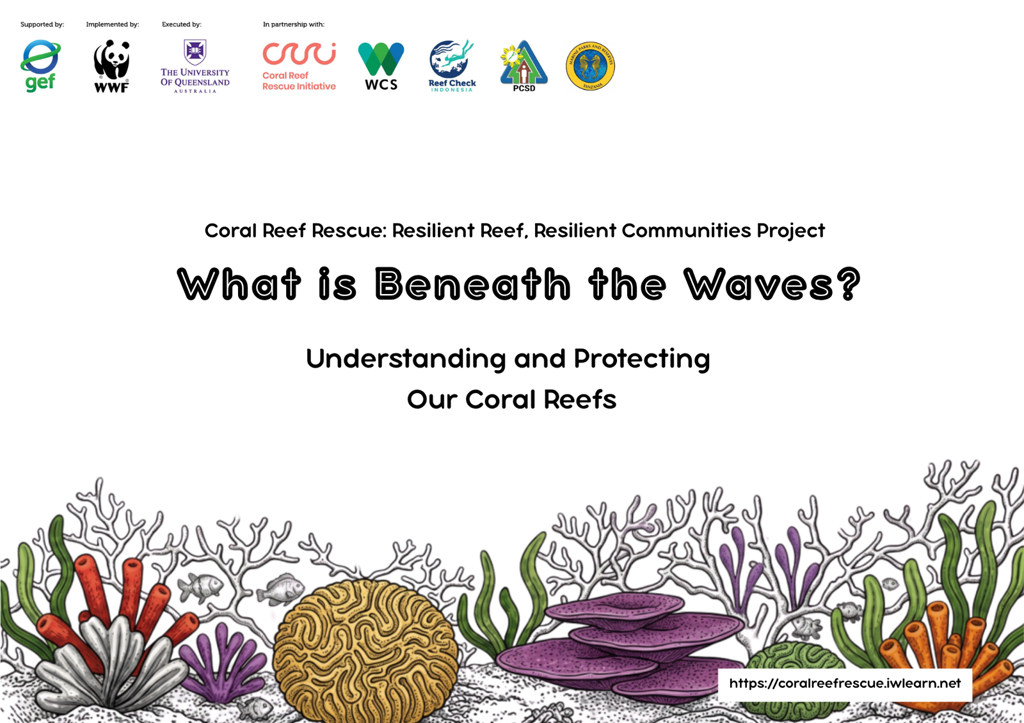
New classroom resources for local communities to explore the world of coral reefs beneath the waves.
Building Resilient Coral Reefs and Communities
The Coral Reef Rescue: Resilient Coral Reefs, Resilient Communities (CRR) Project, funded by the Global Environment Facility (GEF), is focused on safeguarding globally significant climate-resilient coral reefs in six countries: Fiji, Indonesia, Madagascar, the Philippines, Solomon Islands, and Tanzania.
The CRR project focuses on strengthening the conditions that enable countries to protect the health and long-term resilience of their coral reef ecosystems and support the well-being of local custodian communities.
Alongside strengthening institutional cooperation, governance and decision-making processes, the CRR project is committed to improving access to the knowledge and information communities and countries need to achieve their coral reef conservation goals.
Expanding Access to Coral Reef Learning
Four free self-paced online learning courses were designed in collaboration with 32 global experts and our in-country partners to achieve this.
Since the launch of the first Coral Reef Rescue online course in 2025, we have reached over 2,000 learners from 60 countries. Making these online courses freely available in multiple languages has been well received but we know there are still many communities that face barriers to accessing online learning opportunities.
In response to requests from our in-country stakeholders, we are extending our reach to communities with limited digital connectivity by adapting select course content into offline resources.
Introducing the 'What's Beneath the Waves?' Community Learning Guide
Our first resource ‘What’s Beneath the Waves?’ is a community learning guide template designed to raise awareness of coral reef ecosystems, the threats they face and their importance to people and nature.
Informed by community-based education approaches, this resource uses discussion, reflection, and shared experience to support learning. It recognises that participants bring valuable knowledge and perspectives, and that deeper understanding is developed through dialogue.
Designed for Community Facilitators
Importantly, facilitators do not need to be an expert in coral reef conservation to facilitate this resource. The facilitator's role is to guide discussion, encourage participation and create a respectful environment where diverse perspectives can be explored.
While coral reefs around the world share certain common characteristics, each reef is unique, as are the communities that live alongside it. We called the resource a template because we invite you to adapt it to best meet the needs of your intended audience. This may include translating the material into local languages, adding additional material or resources, contextualising the material by using local examples or case studies or by tailoring discussions to reflect community priorities, experience and knowledge.
Adapting Resources for Local Communities
For example, we have been working with our in-country partners at WCS Fiji to adapt this resource for an upcoming community visit focused on raising awareness about coral reef conservation. As facilitators will have access to a screen and projector, we have supplemented the guide with selected videos from our online courses to support discussion and learning. This use case demonstrates the flexibility of the template, which can be adapted in different ways depending on the learning objectives, audience, local context and available technology.
We will continue to work with in-country partners to adapt this resource and develop new useful offline resources, either as stand-alone resources or to complement online learning.
Together, we can make coral reef conservation knowledge more accessible and support communities to protect the reefs that sustain people, livelihoods and cultures around the world.
About the Coral Reef Rescue Project
The Coral Reef Rescue Project is a US$7m Project funded by the Global Environment Facility to build capacity and solutions that ensure the long-term survival of climate refuge coral reef ecosystems and the communities that depend on them. The project is implemented by the World Wildlife Fund and executed by The University of Queensland in partnership with Wildlife Conservation Society (Fiji, Madagascar, Solomon Islands), Yayasan Reef Check Indonesia, Palawan Council for Sustainable Development, Philippines and Marine Parks and Reserves Unit, Tanzania.
Free Online Resources for Coral Reef Conservation
Complementing the work in each country, the GEF 7 CRR project has released free online courses on coral reefs. These include Coral Reefs: Introduction to Challenges and Solutions, Coral Reefs: Sustainable Blue Economy, Coral Reefs: Data and Monitoring, Coral Reefs: Climate Resilient Communities. Courses are available in English, Bahasa Indonesia, and French.
Alongside these courses, a new online decision support tool was created: Coral Reef Rescue Portal. This brings together over 70 existing coral reef datasets and resources in one easy-to-use, searchable platform.
.jpg)