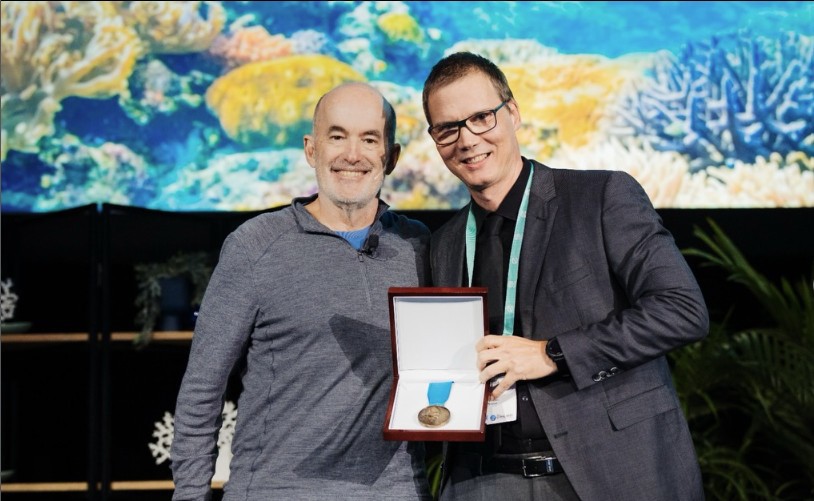
Professor Ove Hoegh-Guldberg Awarded the Prestigious Darwin Medal at the International Coral Reef Society Conference in Auckland, New Zealand
Congratulations to Professor Ove Hoegh-Guldberg on receiving the prestigious Darwin Medal from the International Coral Reef Society, recently awarded at the 16th International Coral Reef Symposium (ICRS 2026) in Auckland, New Zealand, last week. The Coral Reef Rescue Project was inspired by Professor Hoegh-Guldberg's landmark 2018 research, known as the 50 Reefs study, which highlighted the need to protect climate-resilient coral reef regions most likely to withstand climate change and support reef recovery worldwide.
This global analysis, led by The University of Queensland and over 20 scientific and conservation partners, identified coral reefs that have substantially lower exposure to climate change stress due to local oceanographic conditions such as currents and upwellings. These less climate-exposed and well-connected reefs have the ability to support the regeneration of coral reefs worldwide and are therefore referred to as climate refuge reefs.
The CRR Project, funded by the Global Environment Facility (GEF), is now in its fourth year, working with governments and local NGOs to protect globally significant climate-resilient coral reefs in six countries: Fiji, Indonesia, Madagascar, The Philippines, Solomon Islands, and Tanzania.
We extend our sincere congratulations to Professor Hoegh-Guldberg on this well-deserved recognition for his continued dedication to coral reef science and conservation.
Awarded once every four years to a single eminent, late-career Society member, the Darwin Medal recognizes major scientific contributions across a career. Hoegh-Guldberg was unanimously selected by the Society's Honors and Awards Committee for his early projections that ocean warming would intensify mass bleaching and threaten coral reef dominated ecosystems within decades without rapid emissions cuts. Once controversial, these projections have since been supported by increasingly frequent and severe global bleaching events.
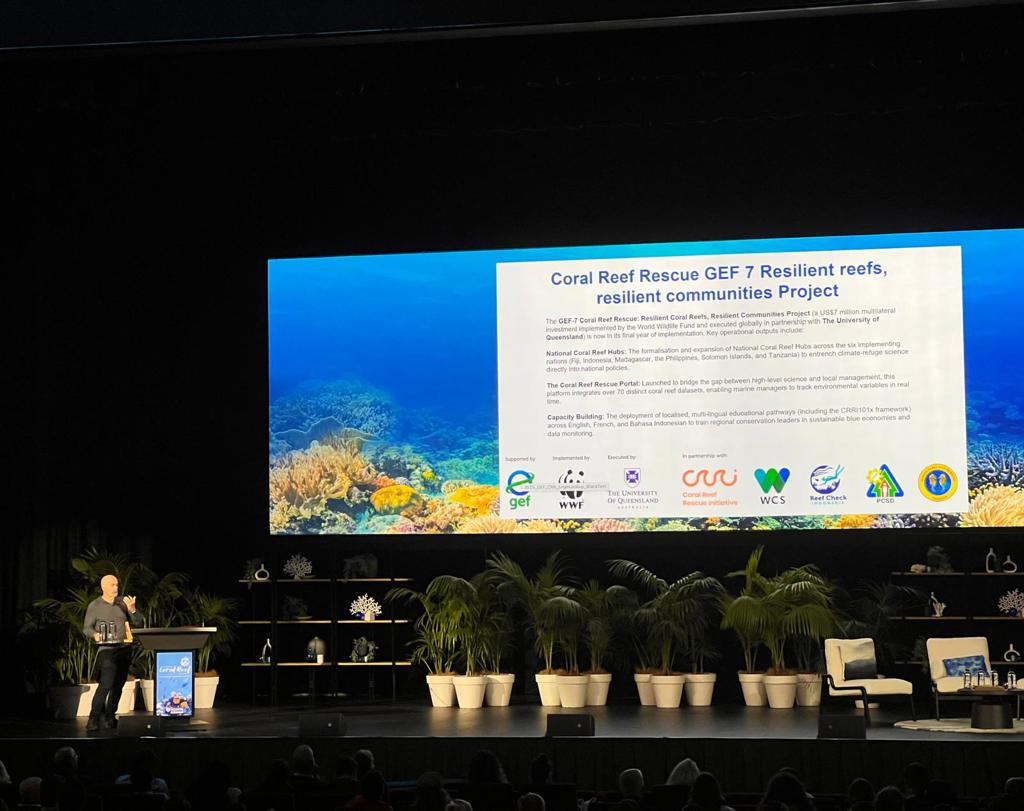
Reflecting on the future of coral reefs, Professor Hoegh-Guldberg said:
“What has made me sad is that we are living in a direction where we are ruining reefs. It’s not too late to save reefs, but we have to amp up our engagement with the corals. It could be a thrilling place to be.
We have the world’s worst problem, climate change facing these reef systems. However, we have the most advanced technology in the hands of many people to do the research and can help us understand how to manage reefs into the future and thereby protect them from loss while we deal with the climate problem.”
Watch this short video with Professor Hoegh-Guldberg highlighting the free online Coral Reef Rescue Courses.
About the Coral Reef Rescue Project
The Coral Reef Rescue Project is a US$7m project funded by the Global Environment Facility to build capacity and solutions that ensure the long-term survival of climate refuge coral reef ecosystems and the communities that depend on them. The project is implemented by the World Wildlife Fund and executed by The University of Queensland in partnership with Wildlife Conservation Society (Fiji, Madagascar, Solomon Islands), Yayasan Reef Check Indonesia, Palawan Council for Sustainable Development (The Philippines) and Marine Parks and Reserves Unit (Tanzania).
Free Online Resources for Coral Reef Conservation
Complementing the work in each country, the GEF 7 CRR project has released free online courses on coral reefs. These include Coral Reefs: Introduction to Challenges and Solutions, Coral Reefs: Sustainable Blue Economy, Coral Reefs: Data and Monitoring, Coral Reefs: Climate Resilient Communities. Courses are available in English, Bahasa Indonesian, and French.
Alongside these courses, a new online decision support tool was created: Coral Reef Rescue Portal. This brings together over 70 existing coral reef datasets and resources in one easy-to-use, searchable platform.
See the full official press release below from the Internataional Coral Reef Symposium announcing the Darwin Medal.
World’s Largest Coral Reef Symposium Spotlights Cutting-Edge Science and Sounds Urgent Climate Alarm at Major Auckland Convening, Brazil Named Next Host Country in 2030
-
2,100+ scientists from 90+ countries mark one of the largest-ever Symposiums
-
New research underscores urgent stakes and call to action for coral reefs amid climate change
-
Society honors Ove Hoegh-Guldberg with its prestigious Darwin Medal, celebrating over three decades of leadership on climate science for corals
-
Next International Coral Reef Symposium announced for Rio de Janeiro, Brazil in 2030
AUCKLAND, NEW ZEALAND (July 24, 2026) – The International Coral Reef Society (ICRS) today wrapped up the 16th International Coral Reef Symposium (ICRS 2026), closing out a record-breaking week that drew more than 2,100 coral reef scientists, conservationists and policymakers from over 90 countries to Auckland, New Zealand.
“The turnout reflects the scale of the international effort now devoted to understanding and protecting coral reefs as they face mounting pressure from climate change,” said Prof. Simon Davy, of Victoria University of Wellington and 2026 ICRS Conference Committee Chair. “Notably, just 80 of the more than 2,125 registered attendees came from host country New Zealand – with scientists and conservationists arriving from more than 90 countries spanning six continents.”
Over five days, the Symposium showcased the latest breakthroughs in coral science – spanning assisted evolution, reef restoration climate modeling, bleaching forecasting, and innovative approaches to community-led conservation – across more than 1,500 oral presentations and 600 poster presentations, making it one of the most substantive scientific programs in the Society's history. Taken together, researchers said, the new findings reinforced a clear message: urgent action for coral reefs is needed now.
“The science is increasingly clear: every fraction of a degree of warming matters, and every reef we can keep functioning matters,” said Christian R. Voolstra, President of the International Coral Reef Society. “We may not be able to save every coral reef, but we can still save many. The question is no longer whether we know enough to act – it is whether we are prepared to act at the scale and speed the science demands.”
The Symposium also served as the occasion for the Society to bestow its highest honor, the Darwin Medal, on Professor Ove Hoegh-Guldberg, Emeritus Professor at the University of Queensland. Awarded once every four years to a single eminent, late-career Society member, the Darwin Medal recognizes major scientific contributions across a career. Hoegh-Guldberg was selected unanimously by the Society's Honors and Awards Committee, whose members cited his early, once-controversial projections – dating to the 1990s and 2000s – that ocean warming would drive intensifying mass bleaching and could collapse coral-dominated reef ecosystems within decades absent rapid emissions cuts, projections that have since been borne out by increasingly frequent and severe global bleaching events. Hoegh-Guldberg delivered the plenary Darwin Lecture at ICRS 2026 in Auckland.
“What has made me sad is that we are living in a direction where we are ruining reefs.” said Prof. Hoegh-Guldberg. “It’s not too late to save reefs, but we have to amp up our engagement with the corals. It could be a thrilling place to be. We have the world’s worst problem, climate change facing these reef systems. However, we have the most advanced technology in the hands of many people to do the research and can help us understand how to manage reefs into the future and thereby protect them from loss while we deal with the climate problem.”
The Society also recognized a slate of 2026 ICRS Award winners spanning career stages and continents: Kimberly Ritchie (USA) received the Eminence in Research Award; Hollie Putnam (USA) received the Mid-Career Scientist Award; and Thomas M. DeCarlo (USA) received the Early-Career Scientist Award. The World Reef Award went to Ahmed Sh Ibrahim Sh Aba (Somalia), and the Coral Reef Conservation Award was shared by Lisa Carne (Belize) and Ranjeet Bhagooli (Mauritius). C. Mark Eakin (USA) and Verena Schoepf (Netherlands) were named ICRS Fellows. The Society additionally awarded Ruth Gates and Graduate Research Fellowships, and a Science Communication Fellowship, to early-career researchers and communicators from the United States, the Netherlands, the Philippines, Australia, Colombia and beyond.
Closing out the week, the Society announced that its next World Congress will convene in Rio de Janeiro, Brazil in 2030, reflecting ICRS's commitment to convening in reef-rich regions and broadening participation from coral reef scientists and communities across the Global South.
“Bringing ICRS to Brazil means bringing it to a region where reef science, policy, and community knowledge intersect in ways that are still underrepresented in the field's major gatherings.” said Prof. Fabiano Thompson, 2030 ICRS Conference Committee Chair. “Brazil is home to the largest reef system in the South Atlantic, with unique taxonomic and ecological features. Hosting the congress here is a chance to widen the conversation, bringing plural voices, southern-hemisphere perspectives, and researchers who don't always have the means to travel north into the center of the discussion.”
The International Coral Reef Society (ICRS) was founded in 1980 and is the principal association to which coral reef scientists, managers, and enthusiasts from across the world belong. Our mission is to promote the acquisition and dissemination of scientific knowledge to secure coral reefs for future generations. Our vision is to be a leader in coral reef scientific discovery, to contribute to the education of future coral reef scientists, and to be a strong voice for science informing policies that protect coral reefs. Learn more and join us at: coralreefs.org
.jpg)