The true cost of illegal fishing: Economic losses and reef degradation in Tanzania’s coastal communities
The 16th International Coral Reef Symposium (ICRS), recently hosted in Aotearoa New Zealand in July 2026, is the world's leading conference dedicated to coral reef science, conservation, and management. Held every four years, the Symposium brings together researchers, practitioners, government representatives, non-governmental organisations, indigenous knowledge holders, students, and marine resource managers from around the world.
This symposium provided Marine Parks and Reserve Unit, Tanzania with an opportunity to share their climate resilient coral reef work with a broad audience of researchers, practitioners, government representatives, non-governmental organisations, indigenous knowledge holders, students, and marine resource managers from around the world.
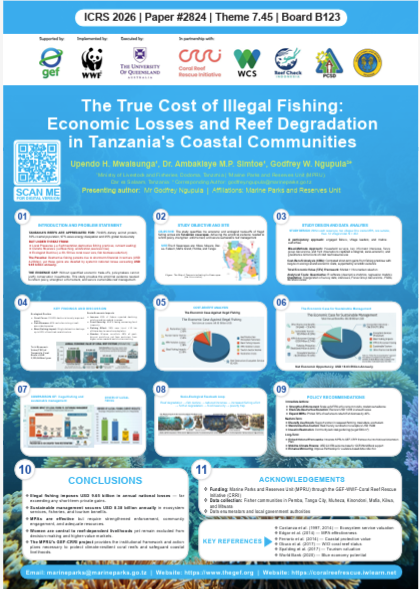
Godfrey Ngupula, Head of Conservation, Marine Parks and Reserve, Tanzania presented a poster on the true cost of illegal fishing “The true cost of illegal fishing: Economic losses and reef degradation in Tanzania’s coastal communities”

Tanzania’s coral reefs have been identified as climate-resilient under the 50 Reefs Project but remain threatened by illegal and destructive fishing, particularly blast fishing and cyanide use. This study used focus groups, household surveys, and secondary data to compare short-term income from destructive fishing with its long-term ecological and socioeconomic costs.
- Findings indicate that destructive fishing has contributed to a 40% decline in fish biomass and a 30–50% reduction in coral cover over the past decade.
- Associated losses include damaged reef habitat, reduced fisheries productivity and tourism revenue, and increased restoration costs.
- Community surveys found that 88% of fishers reported declining catches, while 69% experienced greater food insecurity.
The findings informed Tanzania’s National Action Plan for Coral Reef Conservation, supported by the GEF Coral Reef Rescue Project. The study demonstrates that short-term fishing gains are outweighed by long-term national costs, highlighting the need for stronger enforcement, expanded marine protected areas, community-led restoration, and alternative livelihoods.
“Attendance at ICRS 2026 was highly productive and beneficial. The insights gained, partnerships strengthened, and international recognition received will significantly contribute to advancing coral reef conservation and management in Tanzania” – Godfrey Ngupula, MPRU Tanzania
Latest Updates from Tanzania
- Tanzania's coral reef conservation efforts are gaining national media attention.
- Protecting Tanzania’s Coral Reefs: From Community Action to National Progress
- Tanzania's Marine Parks and Reserves Unit engages the Mafia District to increase awareness about coral reef conservation
- Marine Parks and Reserves Tanzania reach out to local districts and stakeholders to build capacity around safeguarding coral reefs
Free Coral Reef Resources and Tools
The GEF -7 Coral Reef Rescue Project has released free online courses and resources on coral reef conservation. These include;
- Coral Reefs: Introduction to Challenges and Solutions
- Coral Reefs: Data and Monitoring
- Coral Reefs: Sustainable Blue Economy
- Coral Reefs: Climate Resilient Communities
Alongside these courses, a new online decision support tool was created Coral Reef Rescue Portal. This brings together over 70 existing coral reef datasets and resources in one easy-to-use, searchable platform.
Relevant Coral Reef Rescue documents, Tanzania:
- National Action Plan for Conservation of Reslient Coral Reefs, (NAPCRCR), 2026 - 2031
- National Coral Reef Hub, June 2025
- Strategic Action Plan for the Sustainable Management of the Western Indian Ocean Large Marine Ecosystems, May 2019
- The Nairobi Convention
- National Fisheries Sector Policy and Strategy Statement (1997)
- Fisheries Act (2003) Tanzania Mainland
- Tanzania National Integrated Coastal Environment Management Strategy
- National Environmental Management Act (2004)
*Note:The Project Document has more information about Tanzania's reefs and their involvement in the Coral Reef Rescue Project.
About the Coral Reef Rescue Project
The Coral Reef Rescue Project is a US$7 million project supported by the Global Environment Facility to build capacity and solutions that ensure the long-term survival of climate resilient coral reef ecosystems and the communities that depend on them. The project is implemented by the World Wildlife Fund and executed by The University of Queensland in partnership with Wildlife Conservation Society (Fiji, Madagascar, Solomon Islands), Yayasan Reef Check (Indonesia), Palawan Council for Sustainable Development (The Philippines) and Marine Parks and Reserves Unit (Tanzania).
.jpg)