GEF-7 Coral Reef Rescue Project - Core Components
Component 1: Global to local capacity strengthening for climate refuge coral reef monitoring and conservation
Through activities that promote sharing, accessing, and using knowledge to inform action, Component 1 will promote global to local capacity strengthening for the monitoring and conservation of climate refuge coral reefs.
Outputs include the connection of stakeholders to a global knowledge network and best practices, as well as integration of near-real time monitoring of key climate variables (see NOAA’s Coral Reef Watch program) into management strategies. The learning events will be designed to create space and opportunity for exchanging information, experiences and strategies as well as providing access to practical resources, tools, and training. They will be essential for assisting coastal communities in understanding the impacts of global change on critical resources and the changes to follow. This will involve encouraging and supporting individuals participating in the learning events to continue to interact with one another around shared interests and concerns through communities of practice using online platforms. The project will also train and strengthen capacities within project countries on how to use, interpret and adapt near-real time monitoring data for early warning systems and decision-making frameworks.
The learning events and the monitoring system under Component 1 will utilize the CRRI Knowledge Hub. The CRRI Knowledge Hub is an online platform that has been conceptualized to provide a space for knowledge exchange amongst stakeholders across the world involved in the conservation and management of climate refuge reefs. The Hub exists in its first prototype iteration and is being developed to comprise four focus areas:
- Supporting research
- Conservation and community development action
- Teaching and learning
- Monitoring and evaluation.
It is being developed to be accessible to users with a diverse range of backgrounds, expertise, and connectivity (i.e., internet), as well as in languages and cultures relevant to the CRRI countries.
The outcomes in this Component will be realized through a collaborative effort led by the lead executing agency at the global level who will work with local stakeholders to bring together representatives of Technical Working Groups (TWGs) established under National Hubs across the six countries. This group will work together as a ‘Knowledge Unit’ or peer reference group that provides strategic guidance to ensure that the overall vision, approach, activities, and outputs are responsive and relevant to the needs and realities within each country. The TWG will comprise experts and knowledge holders in a range of areas (including technical, pedagogical, Indigenous etc.). This mechanism of participatory collaboration will also allow for consistency of strategies, relevance of produced content (including curriculum development and delivery methods), as well as overall alignment with the goals of the GEF CRR project and its stakeholders.
Component 2: Planning for climate resilient coral reef rescue at the national level
Coral reefs and the livelihoods of local communities dependent on these reefs are influenced and impacted by a wide range of sectors and stakeholders – locally, nationally, regionally, and globally. This includes traditional leaders, local and national government agencies responsible for conservation and natural resource management (including fisheries as well as forestry in the case of mangroves), as well as rural and urban development (agriculture, mining, tourism), private sector actors and research institutes.
Inclusive good governance of climate refuge coral reefs is central in their management and conservation. This includes cohesive and sustainable structures and processes for collaborative diagnosis of threats and root causes, measured prioritization of solutions informed by critical and negotiated analysis of costs and benefits, joint policy and decision making as well as the mobilization of the support and resources necessary to translate decisions into action (Morrison et al., 2020).
This component builds on multisectoral stakeholder platforms and processes that currently exist within the 6 countries to establish integrated approaches specifically aimed at ensuring inclusive management and conservation of climate refuge coral reefs. The theory of change of this component is informed by lessons and experiences with integrated coastal zone management and natural resource governance from the 6 countries and beyond:
- Threats to coral reefs are driven by root causes that emerge from multiple scales. They therefore cannot be addressed by placing the burden of responsibility at the local level alone. Solutions must have the political support of the wide range and diversity of actors and institutions responsible for the drivers of reef degradation.
- Solutions can only be effective if they are based on an analytical understanding of the relationships between interventions from across different sectors and stakeholders and are negotiated to minimize the extent to which one negates the effectiveness of another. Solutions need to be synergistic – negotiated to ensure that interventions are reinforcing so that ‘the combined outcomes exceed the individual effects’ (Ibid). This will need to involve reconciling conservation and development outcomes and aspirations at multiple levels.
- Identifying and planning for synergistic solutions requires that governance structures and processes ensure that the power dynamics between different actors and institutions enable cooperation, learning and adaptive management and action - including finding ways to harness the diversity of knowledge, ways of knowing, values, and aspirations. It also requires awareness of and commitment to upholding human and environmental rights.
To establish inclusive and sustainable good governance structures and processes to underpin planning for climate refuge coral reef rescue at the national level, the intended outcomes under this Component are:
- Increased coordination and collaboration amongst stakeholders across sectors for the inclusive conservation and management of climate refuge reefs over the long term and
- A shared vision and agenda for climate refuge reefs developed through an evidence informed and inclusive planning processes
Specific actions will be taken to ensure that processes are inclusive and fair, allowing for equal voice and opportunity to all stakeholders – particularly the women, men, and youth that are dependent on climate refuge reefs. Efforts will be made to ensure formal recognition and integration within existing government structures and processes at both local and national levels to allow for ownership and longer-term sustainability. This will include integration of the shared vision for climate refuge reefs and synergistic solutions identified for their conservation and management within policies, strategies and plans of relevant economic growth, development, and conservation sectors.
The design of this Component seeks to deliberately promote the longer-term sustainability of the Hub and the Vision for Climate Refuge Reefs. Hubs will be established as a sub-structure within existing platforms and processes in the country. Technical and planning processes carried out across the project will use the Hubs as the core mechanism to engage stakeholders and build ownership of the project’s outcomes. Furthermore, a sustainability strategy for the National Hub and National Vision and Action Plan for climate refuge reefs will be developed early on during the project.
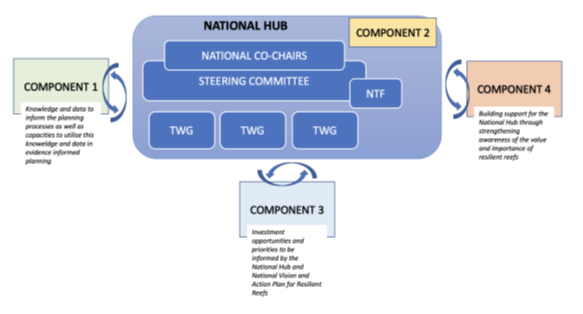
Figure above: Planning structures and processes and their relationship with the GEF CRR Components
Component 3: Financial solutions for climate refuge coral reef rescue
Coral reefs face threats from a range of economic activities that are present in each of the CRR countries, including unsustainable tourism, transport, fisheries, agriculture, forestry, waste & pollution management amongst others. To address these threats, there needs to be a shift from conventional business models that treat damage to coral reefs as an externality, to business models that align to the sustainable blue economy finance principles. The sustainable blue economy includes but is not limited to the adoption of sustainable fisheries and aquaculture practices, ecotourism, circular waste management, regenerative agriculture, sustainable forest management and coastal restoration. There are a growing number of new reef-positive business models centred around the protection and restoration of reef ecosystems.
Component 3 positions CRR to take advantage of the opportunities offered by the growing interest in sustainable blue economy business models around the world, while influencing the way in which each of these economies develop to ensure that they reduce and avoid harm to climate refuge coral reefs. A sustainable blue economy will provide social and economic benefits for reef-dependent communities, protect, and restore the core functions of marine ecosystems, and secure economic stability over time with new economic sectors developed.
Currently, credible investment opportunities in the sustainable blue economy space are limited. Small scale businesses struggle to access capital for growth and larger enterprises are not able to adapt their business models without external support. There is a need to strengthen efforts to identify these opportunities and provide technical assistance to develop a portfolio of ‘investor ready’ opportunities in the blue economy in each of the CRR countries.
Component 4: Knowledge Management and Monitoring and Evaluation
The development of knowledge and understanding of climate refuge reefs is relatively new and, as such, there is a limited understanding amongst policy makers, local communities and the wider public on their significance. Furthermore, in most countries, levels of awareness around the importance of coral reefs, their rate of loss and implications for economies and livelihoods continues to be inadequate to ensure widespread support for their survival.
This component focuses on strengthening support for climate refuge reefs and reaches out to raise awareness to actors and institutions that have the most influence and impact on climate refuge reefs and efforts to ensure their survival. It will create spaces for communities to share their own realities, their reliance on cultural and traditional ties to climate refuge reefs, using their own voices.
Component 4 will also ensure that the project uses monitoring of project progress, experiences, and lessons for adaptive management as well as sharing and communicating more widely at the regional and global level. The project will actively participate in and contribute to IW: LEARN, including PMU attendance at regional meetings, the GEF IW Conference, and twinning exchanges. A website will be developed that is linked and searchable through IW: LEARN’s International Waters Information Management System. This will be used to disseminate project results internationally and to relevant practitioners.
.jpg)