The World's Coral Reefs Are Running Out of Time to Recover — What It Means for Our Regions
A landmark new global assessment has just confirmed what reef communities across Fiji, Indonesia, Madagascar, the Philippines, the Solomon Islands, and Tanzania have long been telling us: coral reefs are suffering.
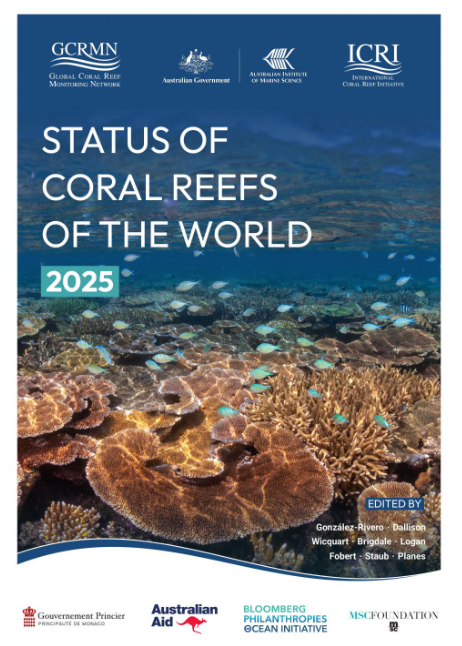
Released on 31 August 2026 by the Global Coral Reef Monitoring Network (GCRMN), the Status of Coral Reefs of the World: 2025 is the most comprehensive assessment of coral reef health ever produced by the Network. This report draws on 21.1 million observations from 87,299 surveys across 36,886 reef sites in more than 120 countries and territories, spanning more than 40 years of data.
-
The report paints a stark picture of coral reef decline: global hard coral cover has fallen by 9.5% from historical levels, driven largely by climate change-induced heat stress. At the same time, large-scale bleaching events are becoming more frequent, occurring every five to six years since 2010 compared with roughly once a decade previously, leaving reefs less time to recover.
-
But recovery is still possible. Global hard coral cover increased by around 6% between 2017 and 2019 when disturbances eased and local pressures were well managed. With nearly one billion people depending on coral reefs for food, income, coastal protection and culture, protecting these vital ecosystems and supporting their recovery has never been more important.
Why this matters for our project countries
The GEF Coral Reef Rescue (CRR) Project operates across three of the ten regions covered in this report. Executed by the University of Queensland, through University of Queensland International Development (UQID), the project works with national governments and conservation partners in the Pacific (Fiji, Solomon Islands), East Asian Seas (Indonesia, the Philippines), and the Western Indian Ocean (Madagascar, Tanzania) to strengthen climate-resilient coral reef management. All three regions face the same core pressures highlighted in the report:
-
repeated marine heatwaves compounded by local stressors like overfishing,
-
coastal development,
-
and poor water quality.
The report's central message lines up closely with the Coral Reef Rescue Project and its approach: local, science-based management can make a measurable difference. Where communities and managers reduce local pressures, through marine protected areas, sustainable fisheries, and improved water quality, reefs have a genuinely better chance of weathering climate-driven heat stress.
By working with governments, Indigenous Peoples, local communities, private sector and conservation partners, the Coral Reef Rescue Project aims to strengthen stewardship of these climate-resilient reefs so we can help protect biodiversity, support sustainable livelihoods and build resilience for the future. The development of National Hubs in each country is driving forward National Action Plans for Coral Reefs. These Action Plans will provide a cohesive roadmap to strengthen climate-resilient reefs and the people and communities whose cultures and livelihoods depend on them.
Please see below some snippets from the relevant chapters of this global report and how Coral Reef Rescue Project, and the sub-executing partners in each country, are working to support the challenges of coral reef conservation in these regions.
Fiji & Solomon Islands (Pacific chapter):
-
Fiji sits in the report's "Tropical Southwestern Pacific" subregion, where hard coral cover has shown no clear long-term change since the late 1990s — instead alternating between decline (2000, 2013–2017) and recovery (2003–2009, 2018–2024). Notably, field researchers observed relatively low bleaching and coral mortality in Fiji through 2023–2024, even during the fourth global bleaching event.
-
The Fijian government is working alongside the National Hub for Coral Reef Conservation and WCS Fiji to advance its new National Action Plan for Coral Reef Conservation.
-
Solomon Islands spans two subregions; the report flags its "Eastern Coral Triangle" subregion (shared with Papua New Guinea) as under-monitored relative to its size — it holds nearly a third of all Pacific coral reef extent, yet the limited number of surveys there leaves too much statistical uncertainty to draw firm conclusions about its trend.
-
CRR's own work in Temotu Province is helping close that gap: WCS Solomon Islands has been documenting how customary "Tambu" areas, managed by village chiefs, are already delivering measurable fisheries spillover benefits, with that local knowledge now feeding into the Solomon Islands' National Action Plan for Coral Reefs.
Indonesia & the Philippines (East Asian Seas chapter):
The East Asian Seas region holds the largest coral reef extent of any GCRMN region — and Indonesia and the Philippines sit across several of its subregions.
-
The "Southern Java and Sunda" subregion (Indonesia) recorded the steepest decline of the whole region: a 22.4% relative drop in hard coral cover between 1987–2009 and 2020–2024.
-
The National Coral Reef Hub in Indonesia is focusing on coordination, shared learning, capacity strengthening alongside collaborative mechanisms that support decision making.
-
A report case study also highlights the Tagbanwa people of Calawit Island, Palawan, whose Indigenous-led reef stewardship — no-take zones, an "adopt-a-reef" scheme, and traditional governance — offers a model for community-led management; reefs in the wider Busuanga municipality that includes their ancestral waters average around 35% hard coral cover.
-
This is particularly relevant to the Coral Reef Rescue project, which officially launched in the Palawan Biosphere Reserve this year.
Madagascar & Tanzania (Western Indian Ocean chapter):
-
The Madagascar and Comoros subregion showed one of the most dramatic swings in the entire report — hard coral cover recovered from just 7% in 1998 to over 45% by 2022, only for the 2024–2025 global bleaching event to trigger the sharpest reversal recorded in the region, pulling cover back down to around 26%.
-
This pattern echoes what CRR's own community consultations are hearing directly from coastal fishers in Madagascar's Ankivonjy MPA. Morgane Dierkens, WCS Madagascar reflects on these meetings “The coastal community spoke with precision and care, pointing out how the colours of the reefs have changed, how fishing grounds have shifted, how the seasons no longer follow the same rhythm. They see the signs of human pressures and the fingerprints of a changing climate in their daily lives.”
-
Tanzania sits in the "East African Coast" subregion, where historical records show some reefs once carried 49–70% hard coral cover (up to 80% at Tutia Reef, Mafia, before 1991) — underscoring how far reefs there have fallen from their historic baseline, even as recent monitoring shows a similar post-2024 decline.
-
In this recent article, published in the Daily News, journalist Harriet Kiama reports on the recent National Steering Committee meeting for the Coral Reef Rescue Project held in Kibaha, Coast Region.
The bottom line
This report highlights the importance of global projects like the Coral Reef Rescue Project working with local in-country partners to deliver national hubs and action plans, and to raise awareness in local communities. As lead author Dr Manuel González Rivero put it, "Reducing global emissions and implementing science-based local conservation aren't alternatives — they have to happen together."
Read the full report: gcrmn.net/2025-report Regional chapters: Pacific · East Asian Seas · Western Indian Ocean
About the Coral Reef Rescue Project
The Coral Reef Rescue Project is a US$7 million project supported by the Global Environment Facility to build capacity and solutions that ensure the long-term survival of climate resilient coral reef ecosystems and the communities that depend on them. The project is implemented by the World Wildlife Fund and executed by The University of Queensland in partnership with Wildlife Conservation Society (Fiji, Madagascar, Solomon Islands), Yayasan Reef Check (Indonesia), Palawan Council for Sustainable Development (The Philippines) and Marine Parks and Reserves Unit (Tanzania).
Free Online Resources for Coral Reef Conservation
Complementing the work in each country, the GEF 7 CRR project has released four free online courses on coral reefs in three languages. These include Coral Reefs: Introduction to Challenges and Solutions, Coral Reefs: Sustainable Blue Economy, Coral Reefs: Data and Monitoring, and Coral Reefs: Climate Resilient Communities.
Alongside these courses, a new online decision support tool was created: Coral Reef Rescue Portal. This brings together over 70 existing coral reef datasets and resources in one easy-to-use, searchable platform.
.jpg)