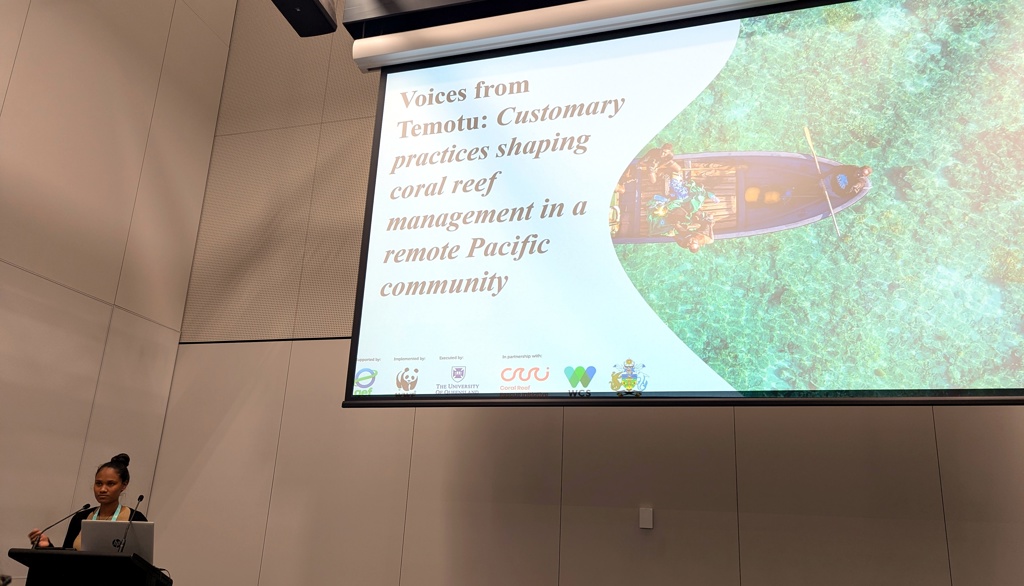
Voices from Temotu: Customary practices shaping coral reef management in a remote Pacific community
The ICRS is the world's leading conference dedicated to coral reef science, conservation, and management. This symposium provided WCS Solomon Islands with an opportunity to share their climate resilient coral reef work with a broad audience of researchers, practitioners, government representatives, non-governmental organisations, indigenous knowledge holders, students, and marine resource managers from around the world.
Doris highlighted how local knowledge is shaping the drafting of the National Action Plan for Coral Reefs in Temotu Province and is ensuring local voices and traditional knowledge is incorporated into decision making.
Synopsis
The Solomon Islands lies within the Coral Triangle, the global centre of marine biodiversity, and supports some of the world's most ecologically rich coral reef ecosystems. These reefs are vital for food security, livelihoods, and cultural identity, but are increasingly threatened by climate change, overfishing, and pollution.
In Temotu Province, geographic isolation has helped limit large-scale commercial exploitation, while communities maintain strong cultural and economic connections to their reefs.
To better incorporate community perspectives into reef management, the Wildlife Conservation Society (WCS) conducted participatory consultations, including community visioning, SWOT analyses, and discussions on locally driven conservation opportunities.
The consultations highlighted the importance of customary practices, particularly Tambu areas, which restrict resource use and are managed by village chiefs. Community members reported positive ecological benefits, including fisheries spillover effects. The unique practice of preserving Nambo (breadfruit) also emerged as a potential alternative livelihood opportunity.
These findings demonstrate the value of combining traditional knowledge, customary governance, and scientific approaches to support community-led coral reef conservation and resilience.
"I had an incredible experience attending my very first International Coral Reef Symposium. I am so grateful that I get to highlight WCS how local knowledge is shaping the National Action Plan (NAP) for Coral Reefs through the Coral Reef Rescue Project in Temotu Province, Solomon Islands.
To be presenting alongside my colleagues, listening to other speakers, and seeing the outstanding poster displays. It has truly been a rewarding experience to connect with my colleagues, NTFs, and learn from other fellow scientists who share the same passion for the corals and the ocean as much as I do.
I am grateful to WCS for the opportunity and to #theGEF for funding my participation at the ICRS through the CRR project #ICRS2026" Doris Kalamasaru
Latest Coral Reef Rescue News from Solomon Islands
New Resources
The GEF -7 Coral Reef Rescue Project has released free online courses and resources on coral reef conservation. These include;
Alongside these courses, a new online decision support tool was created Coral Reef Rescue Portal. This brings together over 70 existing coral reef datasets and resources in one easy-to-use, searchable platform.
About the Coral Reef Rescue Project
The Coral Reef Rescue Project is a US$7 million project funded by the Global Environment Facility to build capacity and solutions that ensure the long-term survival of climate resilient coral reef ecosystems and the communities that depend on them. The project is implemented by the World Wildlife Fund and executed by The University of Queensland in partnership with Wildlife Conservation Society (Fiji, Madagascar, Solomon Islands), Yayasan Reef Check (Indonesia), Palawan Council for Sustainable Development (Philippines) and Marine Parks and Reserves Unit (Tanzania).
.jpg)